




Solution
Osaka National Hospital built an online outpatient booking system on FileMaker Cloud, letting partner clinics confirm referral appointments in real time without hosting any on-premises infrastructure.
Benefits
Partner clinics get instant, on-the-spot booking confirmations, even during evening clinic hours, while the same FileMaker platform powers a standardized electronic disaster medical record system for emergency response teams.
-
Online booking on FileMaker Cloud confirms partner clinic appointments instantly, even during evening clinic hours from 5:00 to 8:00 PM.
-
Referring clinics no longer wait until the next day for a confirmed appointment slip.
-
Treats over 1,000 outpatients daily, accepting nearly 10,000 referred patients annually from partner institutions.
-
A FileMaker-based electronic disaster medical record system, proven during the Kumamoto Earthquake, standardizes documentation for DMAT relief teams.
-

Complements traditional phone and fax referral workflows with a secure, TLS 1.2-encrypted online booking option.
Osaka National Hospital is a core medical institution and advanced general medical facility, serving as a key hospital for cancer, cardiovascular disease, intractable illnesses, AIDS, critical emergency care, and disaster response within policy healthcare fields. With 694 beds, it treats over 1,000 outpatients daily on average.
As a regional medical support hospital, it actively strengthens and promotes coordination with local healthcare institutions, accepting nearly 10,000 referred patients annually (a 65% referral rate) and referring approximately 12,000 patients back to partner institutions (an 88% reverse-referral rate).
Strengthening and advancing regional healthcare coordination.
To facilitate regional medical cooperation, the hospital established a Regional Medical Liaison Office staffed by dedicated coordinators and medical social workers (MSWs). Through dedicated phone and fax lines, the office handles consultation bookings, medical inquiries, discharge planning, and inter-facility coordination with local clinics and hospitals. To complement traditional phone and fax methods, the hospital newly introduced online outpatient booking powered by Claris FileMaker Cloud.
Previously, appointments for patients referred from local clinics were submitted primarily by fax; the hospital would coordinate the schedule and fax back a confirmation. Confirming a booking took time and could not be finalized on the spot, creating challenges where referring clinics had to follow up and inform patients once dates were confirmed.
Online outpatient booking was conceived as the solution, but setting up externally accessible on-premises infrastructure poses immense challenges for healthcare institutions managing sensitive personal information. It required dedicated networks, robust security architecture, and high maintenance to guarantee safe operation.
FileMaker Cloud uses TLS 1.2 encryption for communications requiring strict security and complies with Japan's "Guidelines for the Safety Management of Medical Information Systems" regarding communication over open networks. The online outpatient scheduling system was also deliberately designed to avoid handling personal identifying patient data, ensuring thorough security precautions.
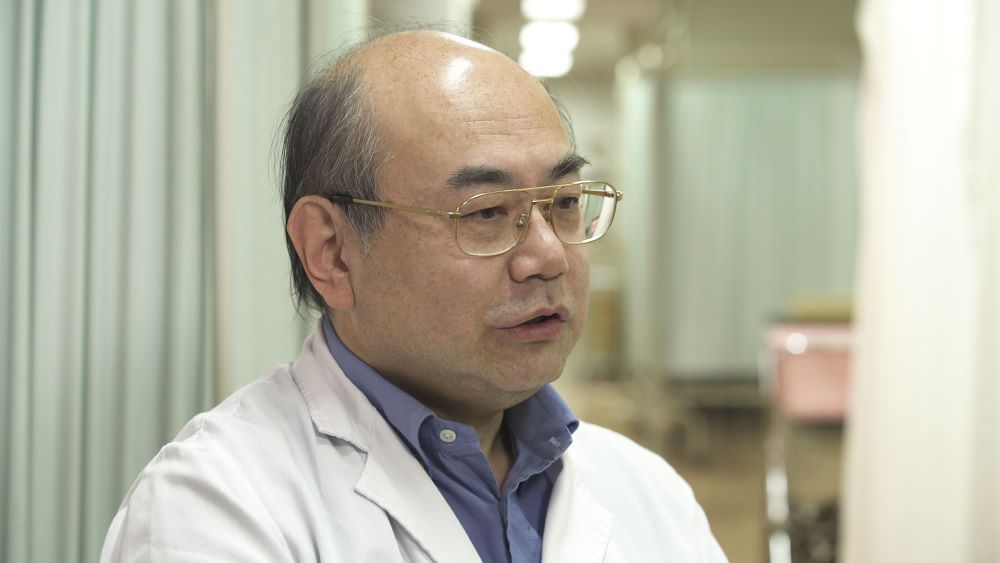
Dr. Atsuhiko Okagaki, Director of Medical Informatics / Chief of Obstetrics, Osaka National Hospital
We adopted FileMaker Cloud as a way to enable secure online booking without hosting a server platform on-premises.
Dr. Atsuhiko Okagaki, Director of Medical Informatics / Chief of Obstetrics
Osaka National Hospital.
"We adopted FileMaker Cloud as a way to enable secure online booking without hosting a server platform on-premises. Additionally, we needed specifications that would allow each department to manage their own schedules, adjusting consultation times and clinic closures independently. Requesting external vendors to develop a system meeting these requirements would have incurred substantial costs. By building it in-house on the FileMaker platform, we were able to create and operate a secure, cost-effective system," says Dr. Atsuhiko Okagaki, Director of Medical Informatics / Chief of Obstetrics.
Bookings possible even during evening clinic hours.
The newly built online outpatient booking system features a straightforward interface and workflow. By not requiring patient names to be entered during scheduling, it maximizes security while leveraging the cloud.
Registered partner clinics log in using their assigned accounts and passwords. Hosted on FileMaker Cloud, the system is accessible via web browsers, the FileMaker Go app on iOS devices, or FileMaker Pro software on PCs. Its simplicity allows referring providers to complete the entire booking application on a single screen after clicking "Start Booking."
Many clinics already owned FileMaker Pro, and FileMaker Go and web browsers are free to use, minimizing adoption overhead for users. Dr. Okagaki notes that low adoption cost and intuitive usability were critical factors in driving widespread adoption.
After selecting the desired clinical department from a list, available dates and time slots are displayed. The provider simply selects the preferred slot, enters only the patient's gender and date of birth, and the booking registration is complete.
Dr. Shigetoshi Yamada, Vice Director of Koshida Clinic, a facility specializing in assisted reproductive technology (fertility treatment) that utilizes this online booking system, explains that immediate, on-the-spot booking confirmation is a significant advantage.
Because many fertility patients at the clinic are employed, the overwhelming majority visit during evening clinic hours from 5:00 to 8:00 PM. When referring pregnant patients to obstetric hospitals, evening hours previously meant the destination hospital was unreachable, meaning faxed requests could not be confirmed until the following day or later.
"Previously, patients had to return on a later date solely to receive their confirmed appointment slip. Now that online outpatient scheduling allows instant confirmation even during evening clinic hours, we can hand them their appointment slip on the spot. This eliminates hassle for patients and saves our staff considerable time," says Dr. Yamada.
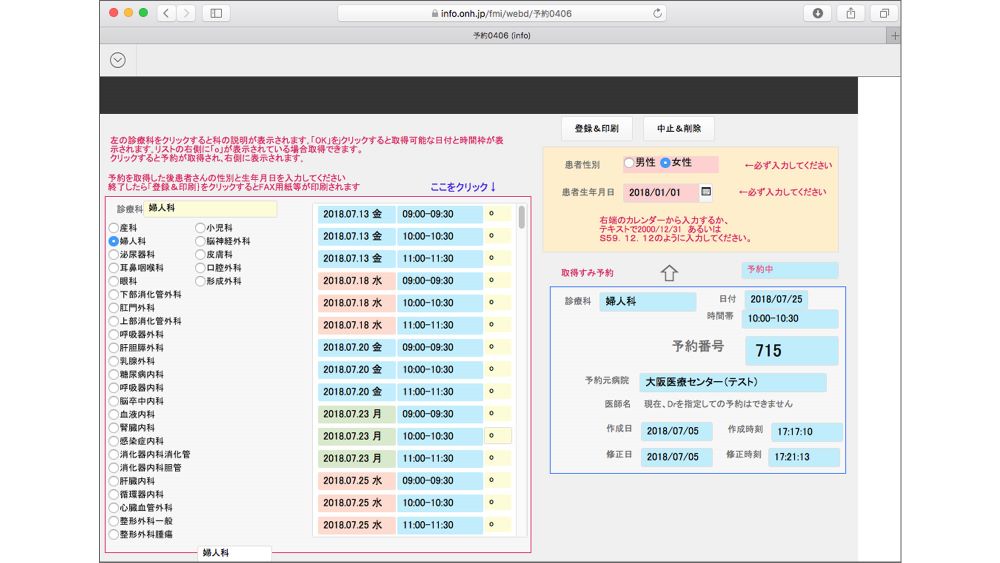
Clinical department, appointment date/time, and referral patient info can be entered on a single screen, enabling immediate on-the-spot booking confirmation.
Digitizing medical records at disaster sites.
Osaka National Hospital also built an electronic disaster medical record system on the FileMaker platform for use by Disaster Medical Assistance Teams (DMAT) and relief squads. This innovative system transforms clinical documentation at disaster sites, an area where digitalization had long lagged.
The specifications for the electronic disaster medical records created by Osaka National Hospital are based on the standardized "Disaster Medical Record" jointly established by five organizations: the Japanese Association for Acute Medicine, Japan Health Information Management Association, Japan Hospital Association, Japan Medical Association, and Japanese Association for Disaster Medicine. Previously, each dispatched medical team used its own unique chart formats and operational protocols.
As a result, handing over patient care between different teams and extracting clinical data in real time were severely hindered. "The Disaster Medical Record was created as the domestic standard format for disasters and is intended for widespread adoption. It carries over data from initial triage tags into the medical chart and is used at Staging Care Units (SCUs) and first-aid stations at hub hospitals, feeding directly into DMAT medical transport records. It also serves as a vital tool for collecting epidemiological disaster data," explains Dr. Daikai Sadamitsu, who served as Director of the Emergency and Critical Care Center until March 2018.
Addressing both emergency trauma and chronic illnesses at relief stations.
The electronic disaster medical record system is based on the FileMaker-based ER progress chart system used at Osaka National Hospital's Emergency and Critical Care Center. It organizes the paper disaster medical record formats (Cover Sheet/Form 1, General/Mild Illness, Trauma, and Progress Sheet/Form 2) into dedicated tabs, "Patient Info," "Internal/Mild," "Trauma/Findings," and "Treatment/Tests," all enterable within a single screen.
Unlike paper records, the system enables repeated entries of findings, assessments, and treatments for patients examined multiple times. Each entry is consolidated on the right side of the screen and displayed in chronological order.
"Particularly in evacuation shelter internal medicine clinics, individual patients often receive multiple consultations, and the attending physician changes almost every time. Being able to easily enter findings and prescriptions each time, while reviewing previous chart notes at a glance, is a tremendous advantage of this electronic disaster medical record system," says Dr. Mitsuhiro Noborio, Senior Physician at the Emergency and Critical Care Center.
The system also supports J-SPEED (Japanese Surveillance in Post-Extreme Emergencies and Disasters), a framework for rapidly aggregating data to assess real-time healthcare conditions in disaster areas. Medical relief teams check 26 standardized items, including patient age, gender, fever, injuries, and stress symptoms, instantly aggregating daily data to report to disaster response headquarters.
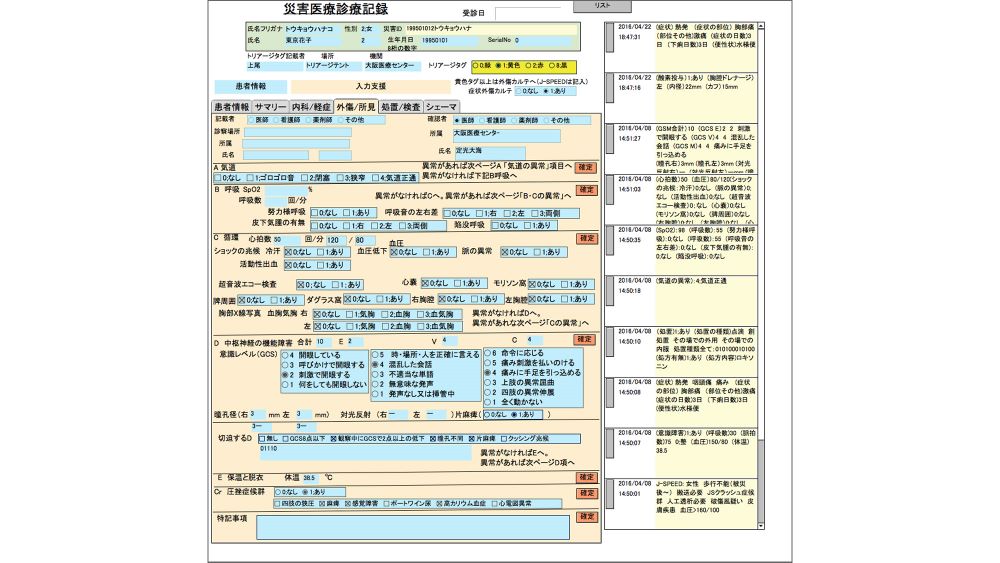
The Trauma/Findings screen follows Japan Advanced Trauma Evaluation and Care (JATEC) guidelines, enabling providers to enter clinical findings via checkboxes.
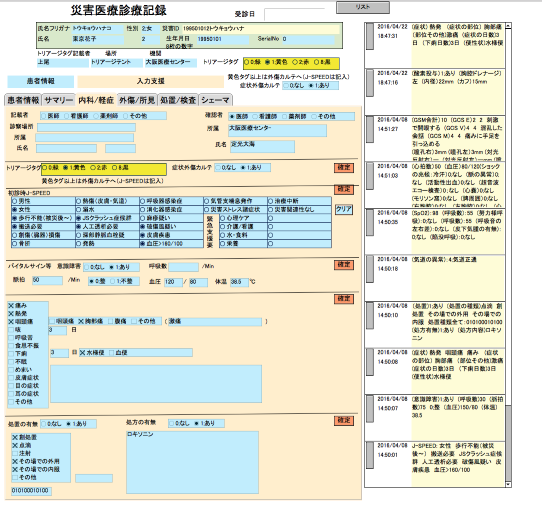
The Internal/Mild screen, used for chronic disease patients and general consultations, incorporates standard clinical documentation fields alongside J-SPEED reporting items.
Preventing communication chaos during disasters.
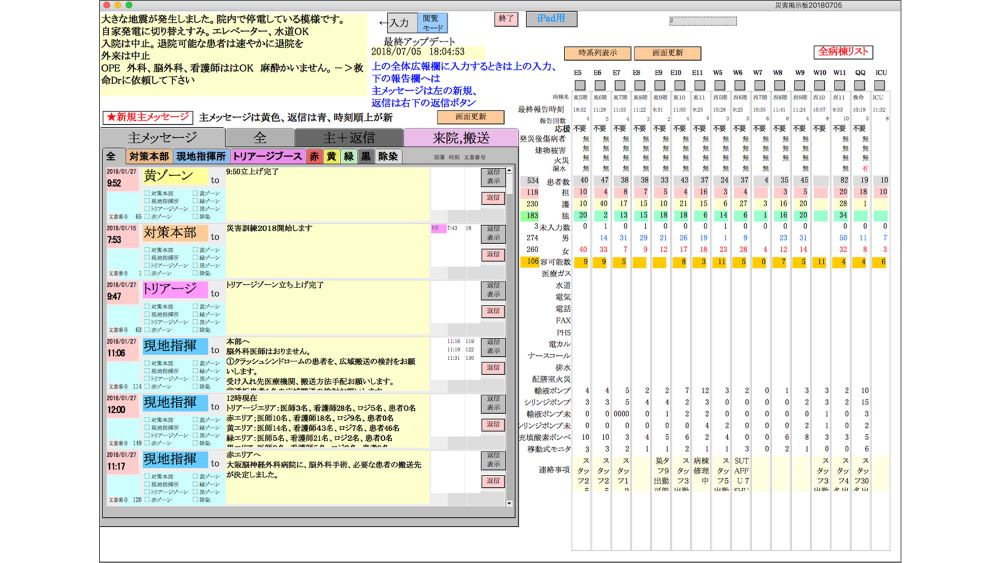
To prepare for disaster scenarios, the hospital also developed an in-house Disaster Bulletin Board system, tested during disaster drills. When a disaster occurs, disaster response headquarters established within the hospital receives a flood of information from triage, treatment, and inpatient ward units.
Traditionally, information arriving from various units via transceivers was handwritten on whiteboards to monitor status and relay messages, often resulting in confusion over who was communicating what to which department. To resolve this, the hospital developed a mechanism allowing each department to post updates directly to the Disaster Bulletin Board system. Posts include timestamps, sender details, message content, and photos, with voice input also utilized to streamline data entry.
During disaster training drills, the system stabilized communication channels, clarified departmental roles, and enabled all units to understand overall operations. Crucially, headquarters received only the essential high-level information it needed, while operational updates were routed directly between relevant departments, successfully eliminating communication chaos.
Functioning similarly to social media timelines, the Electronic Disaster Bulletin Board allows each department to post necessary updates to a shared timeline, facilitating effortless hospital-wide information sharing during emergencies.
National Hospital Organization Osaka National Hospital
Location: 2-1-14 Hoenzaka, Chuo-ku, Osaka, Japan
Industry: Healthcare
Executive Summary
Outpatient scheduling for regional clinics via phone and fax imposed heavy burdens and friction on referring clinics, patients, and Regional Medical Liaison Office staff. Online outpatient scheduling powered by FileMaker Cloud streamlined booking workflows and significantly improved convenience for both healthcare providers and patients.
Meanwhile, the electronic disaster medical record system brought standardized, high-speed documentation to emergency disaster settings where every second counts. By integrating with J-SPEED, it also facilitates the rapid collection and aggregation of data to evaluate medical situations in disaster-affected areas in real time.
System Overview
- Online Outpatient Scheduling: Leveraging FileMaker Cloud, partner medical institutions can confirm appointments with Osaka National Hospital departments in real time via web browsers or FileMaker Go. After logging in with assigned credentials, users complete the entire booking on a single screen by selecting the department, appointment date/time, and entering basic patient info (gender and date of birth).
- Electronic Disaster Medical Record System: Organizes standard paper disaster medical chart forms into dedicated tabs, "Patient Info," "Internal/Mild," "Trauma/Findings," and "Treatment/Tests," within a unified single screen. Medical relief teams can check 26 standardized clinical items, aggregate daily totals, and print or fax reports to disaster response headquarters.
Results & Benefits
- Online Outpatient Scheduling: Drastically reduced workload for referring local clinics and improved patient convenience, while significantly decreasing administrative burden for the Regional Medical Liaison Office.
- Electronic Disaster Medical Record System: Enabled rapid, standardized digital documentation replacing paper disaster charts, with the potential to serve as the standard electronic medical transport record for DMAT operations.
Download the customer story (Japanese PDF) here.
Discover what Claris FileMaker Cloud can do for your organization. Learn more.